Quick decision
| Choose COB when | Choose SMD when |
|---|---|
| Visible light lines and premium uniformity matter | A broad choice of white, RGB/RGBW or addressable formats matters |
| Profiles are shallow or viewing distance is close | The project needs several output or price options |
| The approved sample demonstrates the required appearance | An established repeat specification must be matched |
Installation appearance
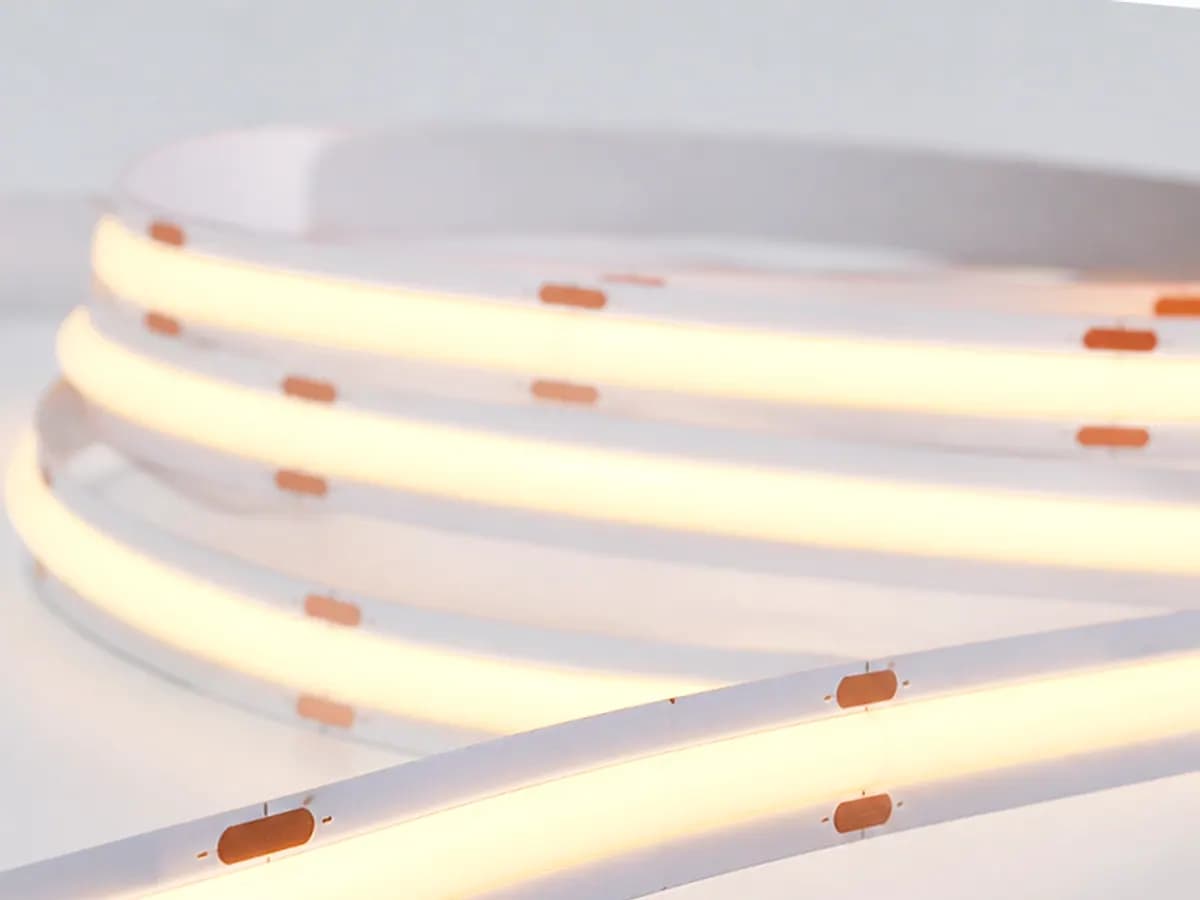
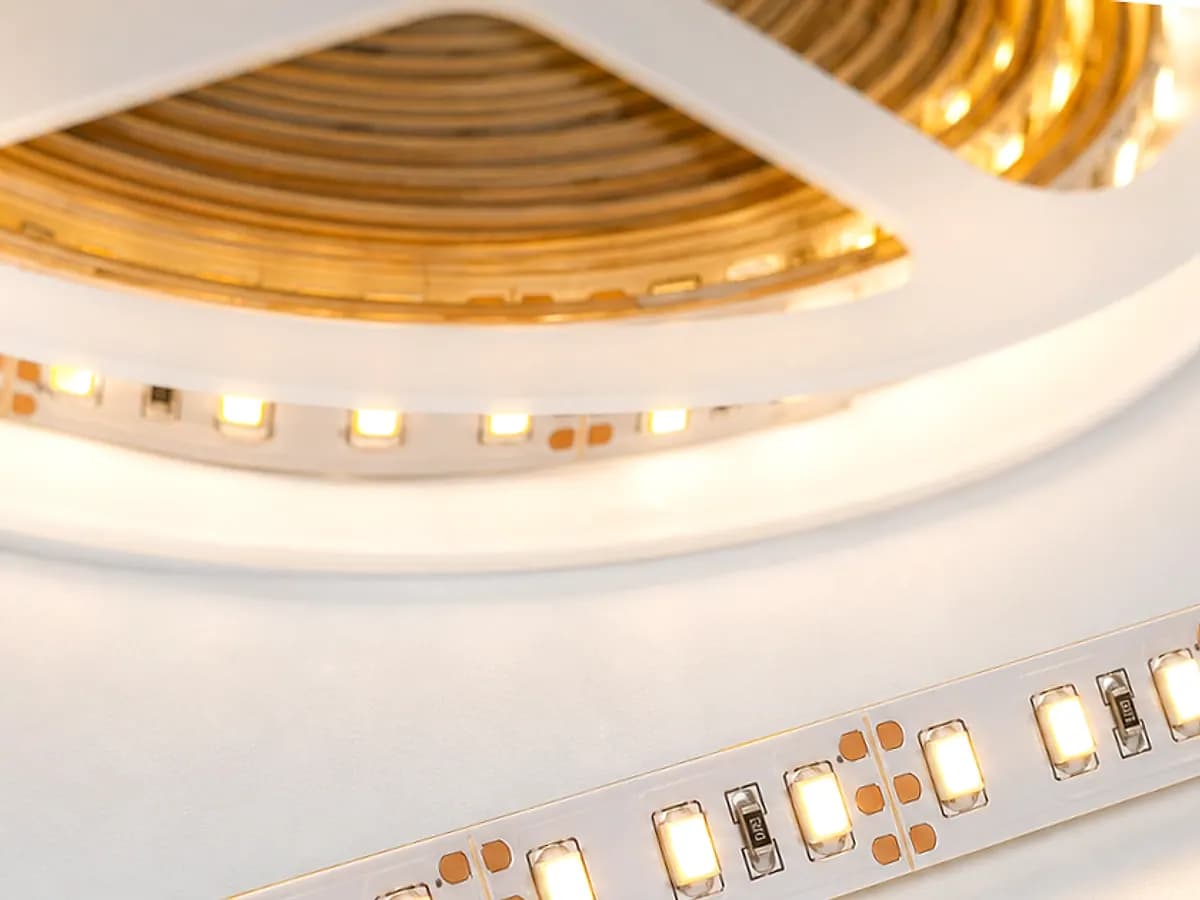
COB construction places many emitting elements beneath a continuous phosphor layer, while SMD strips use visible individual LED packages. COB generally reduces visible dotting, but “dot-free” is not an unconditional guarantee.
The installed result also depends on LED spacing or phosphor coverage, profile depth, diffuser transmission, surface reflectance and viewing distance. Approve appearance in the intended profile rather than from an uninstalled product photo.
Like-for-like performance comparison
| Decision factor | COB | SMD | Approval note |
|---|---|---|---|
| LED construction | Emitting elements beneath phosphor coverage | Discrete mounted LED packages | Inspect the actual sample |
| Visual uniformity | Often smoother at close viewing distances | Depends strongly on package spacing and optical system | Use the same profile and diffuser |
| Profile and diffuser | Can support smooth lines in shallower assemblies | May require more mixing distance depending on package spacing | Approve both strips in the same optical system |
| Output range | Model-dependent | Model-dependent | Compare declared data for matched models |
| White and color control | Available options depend on the range | Often covers broad white and color-control formats | Confirm controller compatibility |
| Width and cutting unit | Model-dependent | Model-dependent | Check fit and material waste |
| Cost and catalog flexibility | Evaluate by approved specification | May suit broader catalog tiers | Compare quotations like for like |
| Typical fit | Visible lines, furniture grooves and architectural details | General white lighting, task lighting, signage and color projects | Application is conditional on the model |
Brightness, power per meter, CRI, CCT consistency, heat behavior, voltage drop, driver loading and dimming compatibility belong to the product specification—not to COB or SMD as a universal category.
For a fair comparison, use the same CCT, similar power, equal run length, the same profile and diffuser, and compatible power supplies. Record feed arrangement and dimming equipment so the result can be repeated.
Sample approval
| Record | Why it matters |
|---|---|
| Model and batch reference | Connects the approved sample with a repeat order |
| Voltage and power per meter | Keeps electrical loading comparable |
| CCT, CRI and available color-tolerance evidence | Documents the required white-light appearance |
| PCB width and cutting unit | Checks profile fit and usable cut lengths |
| Profile, diffuser and viewing distance | Makes the visual review reproducible |
| Run length and feed arrangement | Exposes voltage-drop and wiring differences |
| Temperature after a defined test period | Creates a comparable record without inventing a pass threshold |
| Dimming, adhesive, dotting and color consistency | Captures installation behavior and visible acceptance |
Information to put on the approved sample label
- Model code and batch reference
- Voltage and power per meter
- CCT
- CRI
- IP rating
- PCB width and cutting unit
- Profile, diffuser, run length and feed arrangement
Application decisions
Furniture grooves, shallow profiles, retail displays and hospitality light lines often favor COB when smoothness is visible. Concealed coves can use either construction because profile geometry and viewing distance may hide packages.
High-output task lighting must be selected from verified model data rather than construction alone. Signage and RGB/RGBW projects often favor SMD when broader control formats are required. For cost-sensitive repeat orders, compare approved specifications, replacement continuity and total installed cost.
Distributor catalog strategy
A balanced distributor range is usually more useful than replacing every SMD line with COB. Position COB for smooth visible lines, SMD2835 for general white-light specifications, and SMD RGB/RGBW variants where color control or a wider choice of formats is required.
Do not promise stock, certification or repeat availability without checking the exact model. Keep approved samples and specification records tied to catalog codes.
Final recommendation
FAQ
Is COB LED strip always better than SMD?
No. COB often suits smooth visible lines, while SMD may better suit particular output, color-control, format or repeat-specification needs.
Is COB LED strip guaranteed to be dot-free?
No. COB generally reduces dotting, but profile depth, diffuser, surface and viewing distance still affect the result.
How should buyers compare COB and SMD samples?
Use matched CCT, similar power, equal run length, the same profile and diffuser, and compatible power supplies; then record the exact models and test setup.